> For the complete documentation index, see [llms.txt](https://docs.debot.ai/llms.txt). Markdown versions of documentation pages are available by appending `.md` to page URLs; this page is available as [Markdown](https://docs.debot.ai/en/fee-and-transaction-settings.md).
# Fee & Transaction Settings
### 1. DeBot.AI Service Fee (No Configuration Required)
DeBot.AI charges only **1% trading fee** by default.\
Higher VIP levels enjoy lower fees (see **Referral Program** for detailed rebate rates).\
Each transaction is settled individually, and **no additional platform fees** are charged.
If you have questions about your transaction cost, please first review your **Priority Fee**, **Bribe Fee**, and **Slippage settings**.
#### 📘 Example (Transaction on Solscan)
Here’s a sample transaction on Solana:
#### Breakdown of Transaction Amounts
* **Trade Amount:** 1.609 WSOL
* **DeBot Fee:** 0.016 WSOL (WSOL is the wrapped version of SOL used for trading on the Solana network; 1 WSOL = 1 SOL)
* **Solana Rent:** 0.002 SOL (A network mechanism where the first purchase of a token requires renting an account; the rent can later be manually refunded)
* **Bribe Fee:** 0.003 SOL (An additional fee paid to third-party service providers to help the transaction confirm faster on-chain)
* **Priority Fee:** 0.001285 SOL (A fee paid to validators or miners to ensure higher processing priority during network congestion)
### 2. Gas Fee (No Configuration Required)
**Definition:**\
The *Gas Fee* is the network cost paid to validators when executing transactions or interacting with smart contracts.
* On **Solana**, Gas is paid in **SOL** and typically includes a *Priority Fee*.
* On **Ethereum**, Gas is measured in **Gwei** for convenience since ETH’s value is higher.
* `1 ETH = 1,000,000,000 Gwei` (9 zeros)
***
### 3. Slippage (User Configurable)
#### Explanation
Slippage defines the **maximum acceptable price deviation** for a single transaction.\
For example, if you set slippage to **30%**, a buy order will only succeed if the received token amount is between **70%–100%** of the expected value.\
If the actual received amount is below 70%, the transaction will **fail automatically**.
Setting a proper slippage limit helps prevent unexpected losses from price swings.
#### MEME Trading Tip
In volatile markets, such as MEME coin trading, experienced traders often set a **higher slippage tolerance** to ensure rapid execution amid FOMO/FUD-driven spikes.
✅ **Tips:**
* Manual buy/sell: Auto setting is sufficient.
* Auto buy/sell or pending orders: 30%–35%.
* New or hyped tokens: 50% and above.
***
### 4. Anti-MEV Protection (Anti-Sandwich Mode) — *Optional*
#### Explanation
**MEV bots** (Miner Extractable Value bots) often perform **“sandwich attacks”**—a front-running strategy similar to high-frequency trading.\
The bot detects your pending trade and inserts its own transactions *before and after* yours:
1. The bot **front-runs** your transaction by buying the same token first with a higher fee, causing the price to rise.
2. Your transaction then executes at a higher price, receiving fewer tokens.
3. Finally, the bot **sells immediately** after your trade, profiting from the price difference.
This creates a “sandwich” pattern around your trade, reducing your actual token gain.
#### How to Prevent It
Enabling **Anti-MEV Mode** can effectively prevent sandwich attacks.\
However, it requires a **minimum Priority Fee of 0.012 SOL**.
***
### 5. Priority Fee (User Configurable)
#### Explanation
The **Priority Fee** is paid to validators (or miners) to ensure your transaction is processed **faster**, especially when the network is congested.
✅ **Tips:**
* For normal trades: `0.001 SOL` is generally enough.
* For fast execution in high-load conditions, manually increase the fee.
* Minimum supported by DeBot: `0.0001 SOL`.
***
### 6. Tips (Bribe Fee)
#### Explanation
The **Bribe Fee** is an **extra payment** to third-party service providers to accelerate the transaction’s inclusion in a block.
✅ **Tips:**
* For normal speed: `0.001 SOL` is sufficient.
* For faster execution under congestion, increase the fee manually.
* Minimum supported by DeBot: `0.0001 SOL`.
***
### 7. Token Launch Platform Fees (Auto Deducted; Internal Markets Only)
#### Explanation
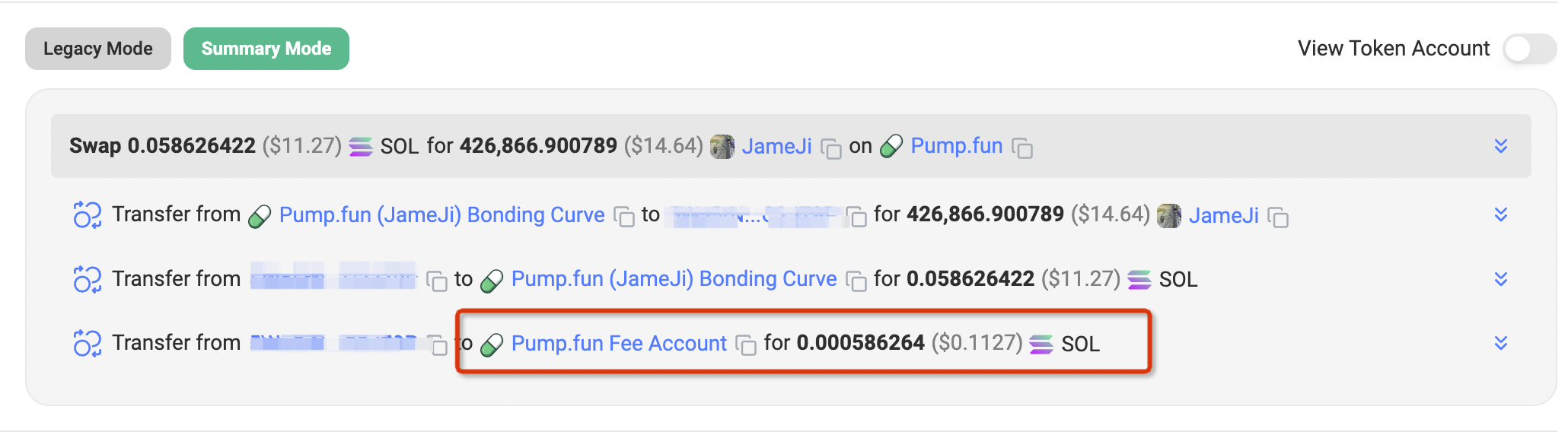
Some tokens, such as those launched on **Pump.Fun**, charge an **additional 1% platform fee** on each trade.\
The exact percentage depends on the token’s launch platform.\
Please refer to each platform’s official documentation for detailed fee information.